# Tunnels and Forwarding

AdaptixC2 provides the ability to use several pivot options. For each of these options, you need to make sure that yours agent supports a specific feature and is in interactive mode (sleep 0). By default, the agent is not put into interactive mode.

### Create tunnels

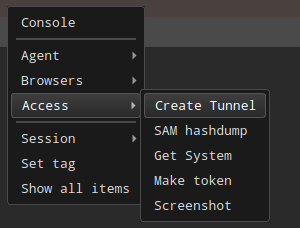
Create a tunnel using the **Create Tunnel** context menu of the session table or graph if the agent supports one of the tunnel types.

<figure><img src="/files/B12mLq361UmpkODSFAu2" alt=""><figcaption></figcaption></figure>

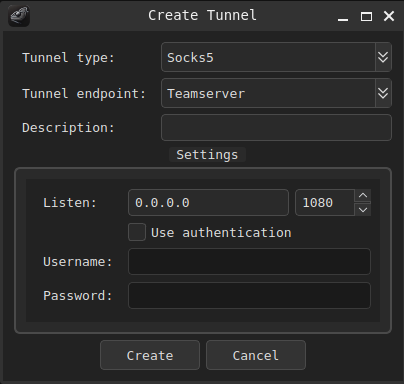
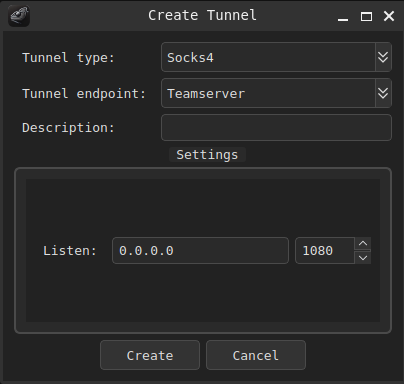
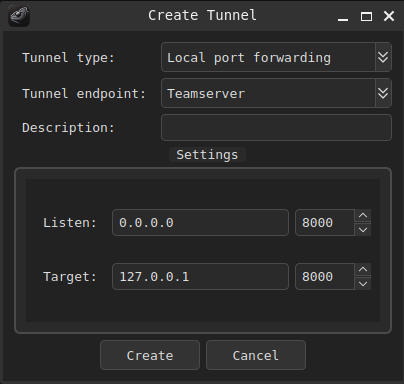
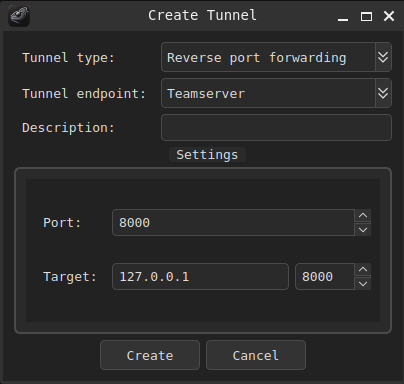
AdaptixC2 supports the following types of network tunnels:

* SOCKS4
* SOCKS5 (with/out Auth) TCP/UDP (IPv4, DNS, **not IPv6**)
* Local TCP Port Forwarding
* Reverse TCP Port Forwarding

{% tabs %}
{% tab title="Socks5" %}

<figure><img src="/files/y2UqgGGNAjeMogAkKyBs" alt=""><figcaption></figcaption></figure>
{% endtab %}

{% tab title="Socks4" %}

<figure><img src="/files/U1rjwPj8LwYnUfepMjvE" alt=""><figcaption></figcaption></figure>
{% endtab %}

{% tab title="Local port Forwarding" %}

<figure><img src="/files/q0TFcjjJZzC2EBH1LDvP" alt=""><figcaption></figcaption></figure>
{% endtab %}

{% tab title="Reverse port Forwarding" %}

<figure><img src="/files/5DUiChhTplC3lftVsomm" alt=""><figcaption></figcaption></figure>
{% endtab %}
{% endtabs %}

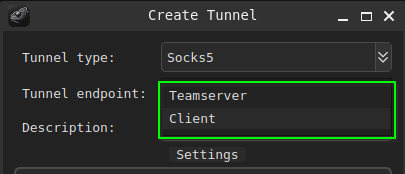
AdaptixC2 allows you to build tunnels not only through the C2 teamserver (route: `-> C2 -> agent -> target`), but also through AdaptixClient.&#x20;

<figure><img src="/files/OW9DV7bkm7mXSnq1b6wB" alt=""><figcaption></figcaption></figure>

In this case, the port is opened on the client and the traffic is directed along the path:  `-> Client -> C2 -> agent -> target`.

### Tunnel manager

Created tunnels are managed via the tunnel manager.

<figure><img src="/files/GBCvZfdGXOdCsZTC80NR" alt=""><figcaption></figcaption></figure>

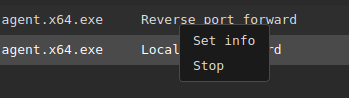
The context menu of the Tunnels Table allows you to set information about the tunnel and stop the tunnel.

<figure><img src="/files/qqZ5xxscyNCS7SkOu2e6" alt=""><figcaption></figcaption></figure>

{% hint style="info" %}
Management of tunnels running through a client is available only to the user through whose client the tunnel is running
{% endhint %}

### Pivots support
<table><thead><tr><th width="237">Agent</th><th width="78" align="center">Socks4</th><th width="78" align="center">Socks5</th><th width="115" align="center">Socks5 UDP</th><th width="124" align="center">Local fwd</th><th align="center">Reverse fwd</th></tr></thead><tbody><tr><td><a data-mention href="/pages/Pt76BxhboepLTqtwUXiL">/pages/Pt76BxhboepLTqtwUXiL</a></td><td align="center">+</td><td align="center">+</td><td align="center">+</td><td align="center">+</td><td align="center">+</td></tr><tr><td><a data-mention href="/pages/VDj56LG8Xn0tuXsXPltO">/pages/VDj56LG8Xn0tuXsXPltO</a></td><td align="center"></td><td align="center">+</td><td align="center"></td><td align="center"></td><td align="center"></td></tr></tbody></table>


---

# Agent Instructions: Querying This Documentation

If you need additional information that is not directly available in this page, you can query the documentation dynamically by asking a question.

Perform an HTTP GET request on the current page URL with the `ask` query parameter:

```
GET https://adaptix-framework.gitbook.io/adaptix-framework/adaptix-c2/tunnels-and-forwarding.md?ask=<question>
```

The question should be specific, self-contained, and written in natural language.
The response will contain a direct answer to the question and relevant excerpts and sources from the documentation.

Use this mechanism when the answer is not explicitly present in the current page, you need clarification or additional context, or you want to retrieve related documentation sections.